Our changing climate is driving sea level rise and more extreme weather events. This is increasing the risk from natural hazards such as flooding from extreme rainfall, coastal flooding, coastal erosion, tsunami, and liquefaction.
Climate change refers to long-term shifts in temperature and weather patterns. Such shifts can be natural, due to changes in the earth’s orbit or large volcanic eruptions. But since the 1800s, burning of fossil fuels including coal, oil, and gas have been the main driver of climate change warming the atmosphere.
Over the last 100 years, global temperatures have risen about 1oC, with sea level rising about 160mm to 210 mm (with about half of that amount occurring since 1993) in response to the warming. Sea level rise is caused by thermal expansion of the ocean as well as melting of glaciers and the Greenland and Antarctic ice sheets.
Our changing climate is also making extreme weather events more powerful and more frequent: stronger cyclones, hotter heatwaves, more frequent droughts and wildfires, and increasingly serious flooding.
The suburbs and communities we build today will last 100’s of years into the future, with all the uncertainty that involves. It is therefore our responsibility to understand the current and future challenges for our city and work with our communities to build in such a way that enables subsequent generations to inherit a safe and liveable environment.
Climate change webpage
How do we understand what climate change will be like in the future?
The trend of warming temperatures and rising sea levels since the mid-1800s is clear from New Zealand and international research, and it is clear this will continue well into the future. However, there are many uncertainties about how the climate may change in the future and how sea level will respond to this.
- How fast will temperatures rise?
- How fast will sea levels rise?
- How high will sea level eventually rise?
- The temperature change won’t be the same across the planet, how will it vary?
Answers to these questions depend on future carbon emissions, as well as on extremely complex atmospheric processes and the water cycle which are not yet fully understood.
To assess what climate change over the next 100+ years might look like the Intergovernmental Panel on Climate Change (IPCC) has created a series of scenarios that represent different paths the world might take over the next 100 years. The IPCC scenarios are not predictions of the future, but rather useful models with which we can plan and stress test ideas of future development.
Climate Change and Sea Level Rise in Tauranga
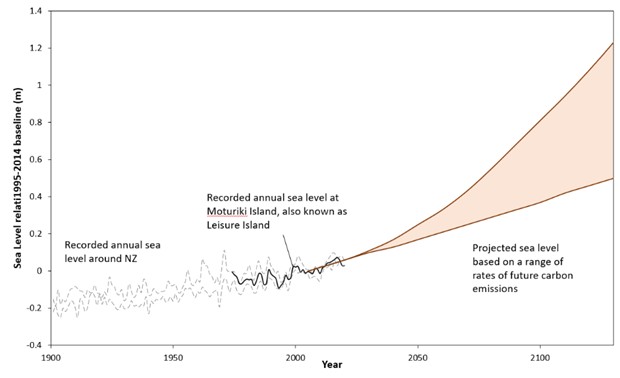
From 1900 to 2020, sea level around New Zealand has increased by approximately 20cm. Our changing climate is predicted to accelerate this rate of sea level rise into the future. The rate of sea level rise in the future is very uncertain as it is dependent on what we do. The below graph shows the past records of sea level in Tauranga and around New Zealand as well as the range of future sea level rise projections. Note future projections do not include vertical land movement.
New Zealand is a dynamic environment, and out land is always moving. This can include vertical changes in the land level resulting from tectonic movement, compacting of sediments among other processes.
National data has previously suggested the Tauranga area may be rising. However, more recent measurements indicate the land is likely either static or sinking. The national data has only a short record and there is significant uncertainty in current vertical land movement data where the error on measurements can exceed 100% of the values themselves. Given the uncertainties and the potential for subsidence, it would be unwise to assume land uplift will offset sea level rise in planning and risk assessments.